

- May 10, 2026
- Jeff Weaver
PPE Requirements by Industry: Why “Standard Gear” Is No Longer Enough
For years, PPE has been treated as one of the simplest parts of workplace safety.
You identify the basics. Hard hats, gloves, safety glasses. You make sure workers have them, and if they are being worn, the assumption has been that the job is done.
That assumption no longer holds.
Recent updates to regulations from WorkSafeBC make it clear that PPE requirements are no longer about what is typical. They are about what is justified. That means PPE must now be selected based on the actual hazards present, not industry habit or past practice.
The Problem With “Standard PPE”
Walk onto most jobsites today and you will still see a familiar pattern. The same equipment is being used regardless of the work being performed.
But hazards do not work that way.
A crew working at height faces very different risks than one operating on the ground. A manufacturing line with airborne contaminants presents a different exposure than a transportation yard with moving vehicles. Yet in many cases, the PPE stays the same.
This is exactly the gap the updated regulations are trying to close.
It is no longer enough to ask, “Do our workers have PPE?”
The real question is, “Is this the right PPE for this specific risk?”
How PPE Requirements Actually Change Across Industries
The shift becomes much clearer when you look at how PPE needs differ across high-risk industries like construction, oil and gas, transportation, and manufacturing.
Construction: When Movement Changes the Risk
Construction has always relied heavily on PPE, especially head protection. But the nature of risk on jobsites is evolving.
There is more movement than ever. Equipment is constantly in motion. Materials are being lifted, shifted, and transported. Even worker mobility has changed with the use of scooters, lifts, and other tools that increase speed and exposure.
Because of this, impact risk is no longer just vertical. Side impact is becoming a much more realistic hazard.
This reflects a broader reality across the industry. PPE is not just equipment. It is part of an interconnected system that ensures protection is consistent and reliable.
Traditional hard hats were designed with falling objects in mind. They do not always provide sufficient protection in scenarios involving lateral impact. That is why updated standards now distinguish between helmet types and require employers to consider how work is actually being performed, not just what has historically been required.
For many organizations, this is where the gap starts to show. The work has changed, but the PPE has not.
Manufacturing: When Exposure Is Less Visible, but More Precise
In manufacturing environments, PPE decisions are often more complex because the hazards are not always obvious.
Noise levels, airborne particles, chemical exposure, and repetitive processes all create risk, but those risks are tied to intensity and duration. That means PPE must be selected with a much higher level of precision.
Providing hearing protection is not enough if it does not meet the required noise reduction for that specific environment. The same goes for respirators. They must match actual exposure levels, not just be available as a precaution.

This is where many programs fall short. Without a clear hazard assessment, PPE becomes a general solution to a very specific problem. Over time, that mismatch creates both safety and compliance risks.
Oil and Gas: Where PPE Becomes a Full System
In oil and gas environments, the expectations around PPE are already more advanced, largely because the risks are higher and less forgiving.
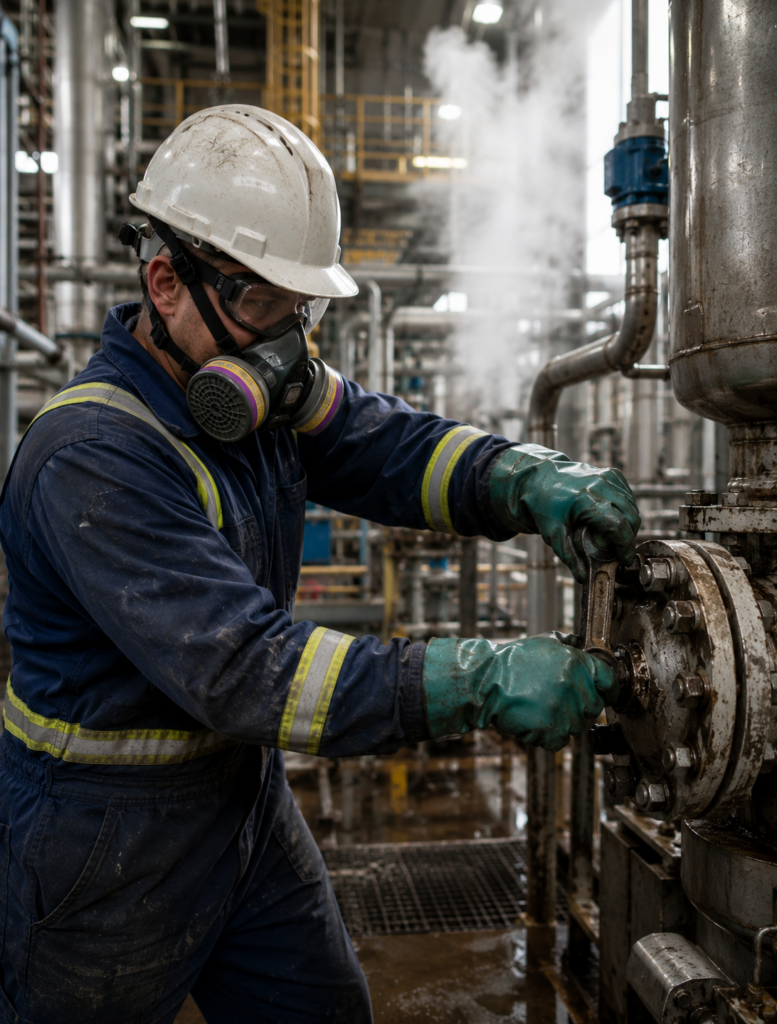
Respiratory protection is a strong example of how compliance has evolved. It is no longer acceptable to simply issue a respirator when conditions require it. That respirator must be part of a structured program that includes fit testing, training, maintenance, and documentation.
This reflects a broader reality across the industry. PPE is not just equipment. It is part of an interconnected system that ensures protection is consistent and reliable.
Organizations that treat PPE as a standalone solution in these environments often find themselves exposed, not because they lack equipment, but because they lack the system that supports it.
Transportation: When Risk Comes From Movement and Environment
Transportation often gets overlooked in PPE conversations, but it presents a unique combination of hazards.
Workers are exposed to moving vehicles, changing weather conditions, loading and unloading risks, and long periods of time in dynamic environments. Visibility becomes critical, but so does protection against impact, fatigue, and environmental exposure.
High-visibility apparel is a baseline, but it is not enough on its own. PPE in transportation needs to account for real-world conditions such as low light, high traffic areas, and unpredictable movement.

This is another area where standard PPE can fall short. Equipment may technically be present, but not truly aligned with how the work is being done.
The Real Requirement: Being Able to Defend Your Decisions
Across all four industries, the expectation is becoming consistent.
It is not about having more PPE. It is about being able to explain it.
If an inspector asks why a certain piece of equipment was chosen, there needs to be a clear answer. That answer should connect directly to a hazard, a level of risk, and a standard of protection.
Without that connection, even the right equipment can become a compliance issue.
This is where many organizations struggle. Not because they are ignoring safety, but because their decisions are not clearly documented or revisited as conditions change.
Where PPE Programs Start to Break Down
Most PPE gaps do not come from missing equipment. They come from small decisions that go unchallenged over time.
Equipment is purchased because it has always been used. Hazard assessments are completed once and not updated. Work conditions shift gradually, but PPE stays the same.
Individually, these do not seem like major issues. Together, they create a disconnect between actual risk and the protection being provided.
That disconnect is exactly what regulators are now focused on.
A Better Way to Think About PPE
The organizations that are getting ahead of this shift are not necessarily using more PPE. They are using it more intentionally.
They are asking better questions:
- What has changed in our work environment?
- Are our current hazards accurately reflected in our assessments?
- Can we clearly explain why each piece of PPE is being used?
By focusing on those questions, PPE becomes less about compliance pressure and more about clarity and control.
The Takeaway
PPE requirements have not just changed. They have become more precise.
They are no longer based on what is standard or commonly used. They are based on what can be justified in the context of real, current hazards.
For construction, oil and gas, transportation, and manufacturing, that shift is especially important. These are environments where risk is constantly evolving, and where small gaps in protection can have serious consequences.
Organizations that take the time to align PPE with actual working conditions, and document those decisions clearly, will be in a much stronger position. Not just during inspections, but in the day-to-day reality of keeping workers safe.