Why close calls aren’t just lucky breaks—they’re warning signs.
“It was just a near miss—no harm done.”
That mindset can be dangerous. A near miss is a safety incident—one that could have caused harm or damage under slightly different circumstances. What prevented it from becoming a serious event? Often, just luck.
Definition refresher: An incident is any unplanned event that results in—or could have resulted in—a loss. That includes near misses.
Understanding the Safety Pyramid
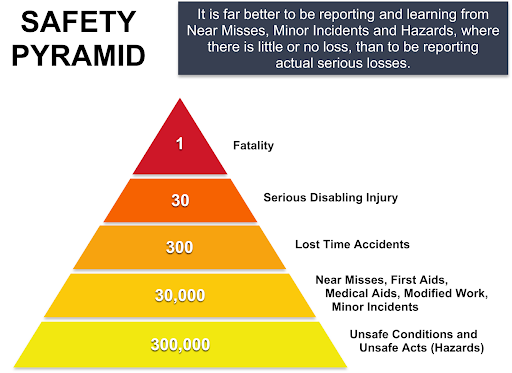
Also known as the accident triangle, the safety pyramid suggests there’s a predictable relationship between serious incidents, minor injuries, and near misses.
The concept was first introduced by Herbert Heinrich in 1931. His research proposed that for every:
1 major injury, there are
29 minor injuries, and
300 no-injury incidents or near misses
Heinrich argued that reducing minor incidents and near misses would lead to fewer serious accidents—a concept that’s shaped health and safety thinking for decades.
Building on the Model
In 1966, Frank Bird expanded on Heinrich’s theory after analyzing over 1.5 million accident reports. He developed a revised model:
1 serious injury
10 minor injuries
30 property damage incidents
600 near misses
Bird’s conclusion? Most serious incidents are predictable and preventable—if we act on early warning signs and address unsafe behaviours.
The safety pyramid has remained a key principle in many workplace safety programs, built around the belief that identifying and addressing near misses can significantly reduce the risk of major accidents.
But... Is It That Simple?
Not entirely. Over the years, critics have pointed out several limitations to the model:
Ratios vary by industry: The numbers proposed by Heinrich and Bird don’t hold up across all workplaces or hazard types.
Hazard types matter: Preventing minor slips won’t necessarily prevent a catastrophic equipment failure—different risks require different approaches.
Too focused on behaviour: Major incidents often involve complex, systemic issues—not just frontline worker actions.
In short, fixed ratios and behaviour-focused models can oversimplify the root causes of serious events.
A Smarter Take on the Pyramid
Despite its flaws, the safety pyramid still offers real value—if used wisely. Here’s how to get the most from it:
Focus on reporting, not ratios. Encourage reporting of all near misses and incidents, regardless of severity.
Dig deeper into risk. Use risk assessments to identify high-impact, low-probability hazards that might not show up in near miss data.
Look beyond behaviour. Investigate systems, processes, and root causes—not just individual actions.
The Bottom Line
Whether or not the triangle holds true in every situation, one principle remains: Reporting near misses and learning from them is a proven way to prevent serious harm.
We’ll explore how to build strong near miss reporting practices in Part 2 of this series.